Connect ERP to accounting software: a finance team's guide
By The AI Ledger editorial team | Published 2026-08-20 | Updated 2026-11-20
Start with a certified pre-built connector wherever your ERP and accounting software both support one. If neither vendor offers a native option, move to an iPaaS platform before you consider a custom build. This order gives you the fastest deployment, the least ongoing maintenance and support you can call when something breaks.
Custom API work or middleware only earns its cost when your data flows are genuinely unusual, multi-entity, or high-volume enough that off-the-shelf tools cannot cope.
> A connector or iPaaS handles the plumbing. Your job is to get the chart of accounts and master data right before a single field gets mapped, because no integration method fixes bad data underneath it.
Three actions to hand to IT or a vendor this week:
- Owner: name one finance lead and one technical lead accountable for the project, not a committee.
- Scope: pick the two or three data flows costing you the most manual rework right now, typically order-to-cash and procure-to-pay, which ERP Research describes as the usual starting point.
- Priority: agree which flows go live first and which can wait, so testing does not sprawl across the whole ledger at once.
Key Takeaways
| Point | Details |
|---|---|
| Start simple | Use a certified pre-built connector or iPaaS before considering custom API or middleware builds. |
| Fix the chart of accounts first | Align one chart of accounts before mapping any fields, or reconciliation stays inconsistent after go-live. |
| Decide data ownership early | Agree which system is the source of record for each data type before development starts. |
| Prioritise order-to-cash and procure-to-pay | These flows typically remove the most manual rework. |
| Test reconciliation, not just connectivity | Build tolerance rules for timing drift and rehearse your rollback plan before go-live. |
| Settle UK GDPR before you sign | Get the data processing agreement and subprocessor list from the vendor before contract signature. |
Table of Contents
- How do you connect ERP to accounting software?
- What are the benefits of connecting ERP and accounting software?
- A step-by-step guide to integrating your ERP with accounting software
- How do you choose the right integration approach?
- What are the common pitfalls in ERP to accounting integration?
- Which vendors and systems do businesses commonly connect, and how?
- What security and testing checks belong on your go-live checklist?
- UK data protection and HMRC points to settle first
- How does the technical connection actually work?
- How to keep the integration running after go-live
- Build your shortlist before you brief a vendor
- Frequently asked questions
- Sources
How do you connect ERP to accounting software?
There are four main routes, plus two that matter in particular estates. Each trades speed against control.
!Comparison diagram of ERP integration methods
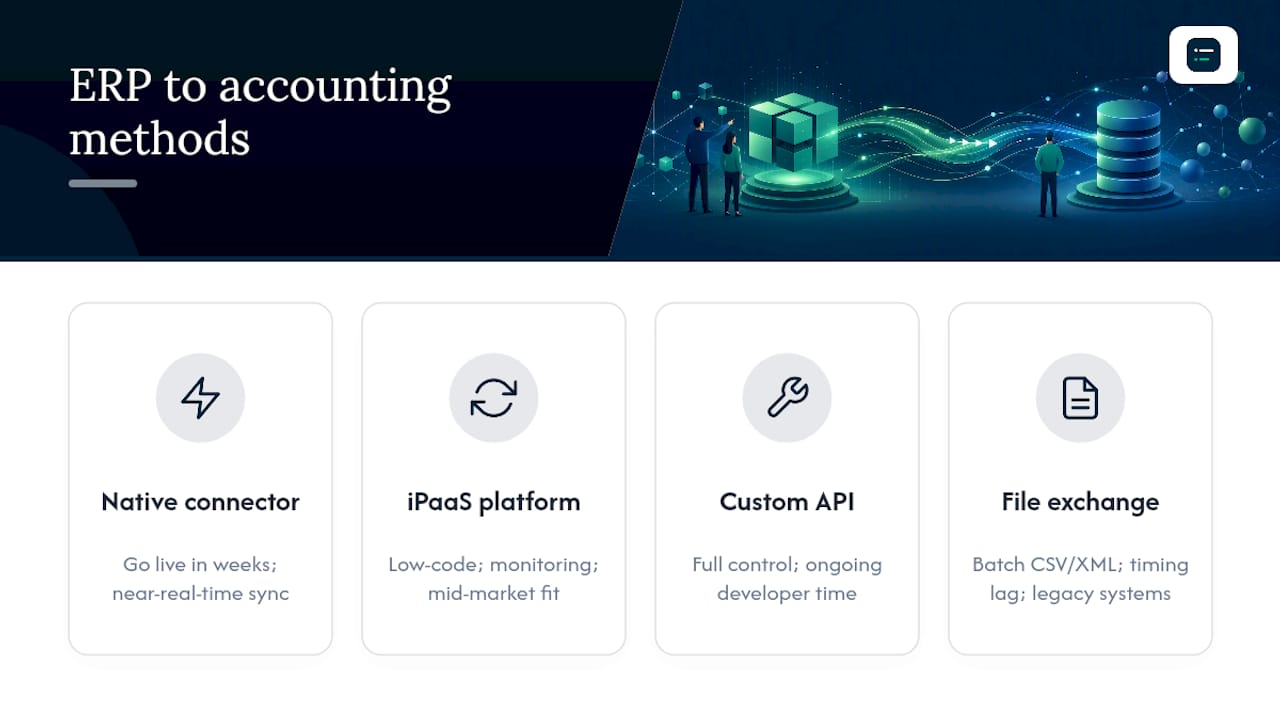
Native or pre-built connectors are ready-made links between named systems, configured through settings rather than code. They suit small and mid-sized businesses that want to go live in weeks, not months. Pre-built Xero connectors, for instance, offer two-way, near real-time sync with OAuth 2.0 security built in. The caveat: connectors are built for standard set-ups, so never assume one is plug-and-play for non-standard fields.
!Hands adjusting settings on server rack dial

iPaaS (integration platform as a service) platforms sit between systems and use visual, low-code mapping tools plus built-in monitoring and retry logic. The provider updates connectors when upstream APIs change. They fit mid-market firms with several systems to connect and no in-house developer team, and can cut deployment from quarters to weeks. The trade-off is dependency: if the platform goes down, your integrations stop, so plan a manual fallback for critical flows.
Unified APIs put several accounting platforms behind one normalised layer. You build once against a standard schema for invoices, payments, contacts and ledger accounts, and the provider handles each platform's translation and authentication. This suits software vendors and practices that need to support Xero, QuickBooks, Sage and FreeAgent at the same time.
Custom API integration gives you full control over logic and data handling. Your team then owns the error handling, retries, token refresh, monitoring and every fix when the ERP vendor changes its API. Reserve it for genuinely unique processes.
File or EDI exchanges (batch CSV or XML transfers, or EDI standards such as EDIFACT, ANSI X12 and TRADACOMS) remain common for legacy systems and for trading partners who mandate them for purchase orders and invoices. They are batch by nature, so data is only as current as the last run.
Point-to-point scripts link two systems directly. They are cheap to build but scale badly: ten systems linked pairwise can need up to 45 separate connections, each with its own error handling and update cycle. Large on-premises estates that need heavy protocol translation sometimes use an enterprise service bus (ESB) instead, which needs a dedicated integration team to run.
Pro Tip: _Most successful projects mix methods. Use a native connector for your core AR/AP flow and a simple file export for a low-volume, quarterly reporting feed nobody wants to pay to automate properly._
What are the benefits of connecting ERP and accounting software?
Once the two systems talk to each other, most of the manual rekeying disappears. Invoices raised in the ERP post directly as entries in your accounting software. Payments received update accounts receivable without anyone touching a spreadsheet.
That has a direct effect on how fast you can close the books:
- Automated AR/AP posting removes duplicate data entry and the errors that come with it.
- Near real-time visibility of cash and stock replaces end-of-month guesswork.
- Reconciliation is faster because both ledgers already agree on most transactions before you start.
Real-time two-way sync between operational and financial systems means month-end close work shrinks, because records match daily activity rather than a batch export run once a month. That change is often the business case that gets a project approved.
A step-by-step guide to integrating your ERP with accounting software
Phase 0: Define scope and sponsor. Get an executive sponsor, agree objectives in writing, and prioritise order-to-cash and procure-to-pay.
Phase 1: Write the requirements and align the chart of accounts. A shared chart of accounts across both systems, agreed before any build starts, removes the most common cause of reconciliation trouble after go-live. In the same workshop, decide which system is the source of record for each data type: customer master, item, price, stock quantity and invoice status. Conflicts between systems almost always trace back to two systems both believing they own the same field.
Phase 2: Map the data. Decide field by field how ERP customer records map to accounting contacts, how item codes map to nominal codes, and who owns master data going forward. Watch for fields that look the same but mean different things, such as "ship date" in the ERP and "despatch date" in the warehouse system, and get business owner sign-off on the mapping document.
- Build unit tests for individual field mappings.
- Run integration tests across full transaction cycles.
- Run user acceptance testing (UAT) with real finance staff and realistic volumes, not just IT.
- Set reconciliation rules and a documented fallback if the sync fails.
Phase 3: Go live. Take a full backup, agree a cutover window, define rollback criteria, and monitor the first week closely.
Panorama Consulting's ERP research is a useful reminder that discovery and mapping drive much of the cost and time in ERP projects; compressing them tends to move the work into testing, where it costs more.
Pro Tip: _Budget more time for data cleansing than for the technical build itself. Messy supplier records are the time sink teams most often underestimate._
How do you choose the right integration approach?
Match the method to your actual transaction volume and complexity, not to what sounds impressive in a vendor pitch.
| Evaluation dimension | Native connector | iPaaS | Unified API | Custom API / middleware |
|---|---|---|---|---|
| Best for | SMB, single entity | Mid-market, multiple systems | Supporting several accounting platforms | Enterprise, unique processes |
| Sync type | Real-time | Near real-time | Near real-time | Real-time or batch |
| Complexity and maintenance | Low | Moderate | Low, vendor-managed | High |
| Cost and timeline | Low cost, weeks | Moderate cost, weeks to months | Subscription, weeks | High cost, months |
| Data types supported | Invoices, AR/AP, payments | Invoices, AR/AP, inventory, projects | Standard accounting objects | Any, including bespoke fields |
| Support | Vendor-managed | Platform-managed | Provider-managed | Internally managed |
Score options over three years, not on build cost alone. Maintenance dominates long-run spend, and a cheap point-to-point build can cost more over time than a well-configured iPaaS subscription once you are patching several connections every time a vendor changes its API.
High transaction volumes, multiple entities with different charts of accounts, or industry-specific reporting rules all push you towards iPaaS or custom builds. Watch for these red flags before committing to any method:
- Neither system publishes documented APIs.
- Your entities run on genuinely different charts of accounts with no mapping plan.
- Master data (customers, suppliers, items) is already duplicated or inconsistent across systems.
Questions to ask an integration vendor or partner:
- How many live integrations of this type have you delivered in the last 12 months, and can we speak to references?
- How quickly do you update connectors when the ERP or accounting platform releases a breaking API change?
- How do you monitor integration health, and what does alerting and incident response look like?
- Where is data processed and stored, and can you offer UK or EEA residency?
- What does your disaster recovery plan cover, and what is the recovery time for a full platform outage?
- Will you provide a data processing agreement and a subprocessor list before contract signature?
- Which data objects sync both ways, and which are read-only? Many "integrations" only push one way, which leaves reconciliation with your team.
For a wider vendor scorecard, see our accounting software evaluation criteria.
What are the common pitfalls in ERP to accounting integration?
Mismatched chart of accounts tops the list. Normalise the mapping before go-live rather than patching it in production.
Duplicate customer or supplier records creep in when both systems allow free-text entry, and an integration copies every duplicate across. Run a de-duplication pass before the first sync, not after.
Timing differences between systems cause reconciliation drift, where balances briefly disagree because one system posts before the other. Build explicit reconciliation rules and a tolerance window rather than chasing every penny in real time.
Permission misconfigurations quietly cause many failed syncs. Audit role-based access before launch, and monitor for silent authentication failures afterwards.
API drift happens when a vendor changes its API and an integration breaks without anyone noticing. Use versioned API calls and a daily automated test against a staging environment.
Pro Tip: _A one-day reconciliation drift is normal in the first weeks of a new sync. A drift that keeps growing week on week signals a mapping error, not a timing quirk._
Which vendors and systems do businesses commonly connect, and how?
Recognising your own stack in a real scenario helps you pick the right method faster.
- Small business, cloud-first stack: a firm on Xero connecting to a cloud ERP or ecommerce platform typically uses a native connector. Main cost driver: configuration, not development.
- Mid-market, multiple systems: a business running Sage 200, QuickBooks or Microsoft Dynamics 365 Business Central usually chooses an iPaaS to connect CRM, warehouse and payroll data alongside the ledger. Main cost driver: mapping and testing effort.
- Enterprise, complex reporting: a business on NetSuite with multiple entities, or a firm needing German compliance through DATEV, tends to use middleware or custom API integration. Main cost driver: custom development and UAT cycles. Our guide to automation tools for multi-entity accounting covers the extra mapping work when several entities share one ERP.
Tools such as Zynk sit in the iPaaS and middleware space specifically for accounting, and Zynk's public repositories show common adapter patterns worth reviewing before you scope a custom build.
The systems that most often sit either side of the ledger, and how their data usually moves:
| System | Data that moves | Usual timing |
|---|---|---|
| CRM (Salesforce, HubSpot) | Customers, quotes, orders, invoice and payment status | Real-time for orders, batch for account updates |
| Ecommerce (Shopify, WooCommerce) | Orders, refunds, fees, stock levels, prices | Real-time for orders, batch for catalogue and pricing |
| Warehouse management | Goods receipts, despatches, stock adjustments | Near real-time for despatch, batch for stock counts |
| Payroll | Pay run journals, employer NI, pensions, cost centres | Batch after each pay run |
| Expenses (for example Expensify) | Categorised claims and receipts | Near real-time or daily |
| Bank feeds | Bank transactions for reconciliation | Daily |
| BI and reporting (Power BI, Tableau) | Transactions, cost centres, operational metrics | Batch or near real-time, read-only |
| Tax tools and HMRC MTD APIs | Transaction tax data, VAT returns | Per transaction, then batch at period end |
An ecommerce order is a good test of your design. The integration has to resolve which price list applies, whether stock is available in the right location, which VAT rate applies to the delivery address and which legal entity owns the sale. Each is a data ownership question, not a technical one.
Pro Tip: _If your stack matches one of these scenarios closely, ask your vendor directly whether a certified connector already exists for that exact pairing before assuming you need custom work._
What security and testing checks belong on your go-live checklist?
Sign off on these before any live financial data flows through the connection.
- Confirm authentication uses OAuth 2.0 or secure, rotated API keys, not shared static credentials.
- Verify role-based access control restricts who can view or post transactions.
- Confirm data is encrypted in transit and at rest, with audit logging enabled and a retention policy set.
- Run performance testing at peak transaction volumes, not just typical daily loads.
- If you connect many client or entity ledgers, check that each one's OAuth tokens are stored and refreshed separately, so data cannot cross between accounts.
Beyond the standard test cycle, run a full backup and recovery drill and confirm reconciliation testing catches out-of-balance conditions automatically.
- Set alerting for failed syncs within minutes, not hours.
- Flag any transaction that posts to accounting but not ERP, or the other way round.
Pro Tip: _Test your rollback plan before go-live, not during an incident. A rollback you have never rehearsed rarely works cleanly under pressure._
UK data protection and HMRC points to settle first
Any integration that moves customer, supplier or employee data is processing personal data under UK GDPR and the Data Protection Act 2018. Settle these during planning:
- Data processing agreement: UK GDPR Article 28 requires a written contract with any processor handling personal data for you. Ask for it, and the subprocessor list, before you sign. (ICO guidance on controllers and processors)
- Data minimisation: send only the fields the receiving system needs.
- International transfers: if the platform processes data outside the UK, you need a transfer mechanism such as the International Data Transfer Agreement or the UK addendum to the EU standard contractual clauses. (ICO international transfers)
- Deletion and access requests: record which systems hold personal data, so a deletion request reaches every copy.
- Payroll and RTI: payroll submissions to HMRC under Real Time Information must come from HMRC-recognised payroll software, so keep the submission inside that software and integrate the journals, not the filing. (GOV.UK: find payroll software)
How does the technical connection actually work?
Modern ERPs expose REST APIs or, in older systems, SOAP or XML gateways, so operational events can trigger accounting entries automatically as two-way sync rather than a one-way export. Webhooks push changes as they happen; older platforms need polling on a schedule, which adds unavoidable delay.
Behind that sits data transformation: mapping ERP field formats to accounting field formats, and building idempotency into every write so a retried API call never posts the same invoice twice.
Before development starts, get written answers to these questions from your vendor or developer:
- What are the API rate limits, and what happens if we exceed them?
- How are errors surfaced, and can we subscribe to failure alerts?
- How is the API versioned, and what is the deprecation notice period?
Pro Tip: _Ask specifically about monitoring endpoints. A connector without a health check dashboard leaves you finding out about failures from an unhappy customer, not a system alert._
How to keep the integration running after go-live
Go-live is the start of running the integration, not the end of the project. APIs change, volumes grow and business rules move on.
- Named owner: assign one person to each integration. Ownerless integrations decay quietly.
- Error queue and retries: failed messages should land in a queue with a retry policy and a routine for reviewing and reprocessing them.
- Logging: log each message as it enters, transforms and lands, so root causes are quick to find.
- Thresholds: set acceptable delay and error rates for each flow and review them quarterly.
- Runbook: write down how to reprocess a failed batch, rotate an expired key, handle a vendor outage and run order, payroll and stock processes by hand until service returns.
Start small and expand. Teams want every system talking to every other system on day one, when the better move is picking two flows, getting the chart of accounts aligned and proving it works before adding more.
Build your shortlist before you brief a vendor
Before you brief IT or an implementation partner, it helps to know which accounting tools support the connector or iPaaS pairing you need, and which will leave you paying for custom development. The AI Ledger is a directory of 300+ AI accounting tools with independent reviews, so you are not relying on a vendor's own sales page to tell you what its connector does.
The tool finder matches your stack and task to relevant options, whether you are checking accounting workflow automation options or comparing platforms outright. Every listing carries an editor score and a last verified date, and none of those scores are for sale.
Frequently asked questions
Does ERP software already include accounting? Most ERPs include a general ledger module, but dedicated accounting software often offers deeper compliance features, tax handling or reporting that finance teams prefer to keep separate. That is why the connection between the two matters.
How do you integrate invoicing between ERP and accounting software? Map invoice fields (customer, line items, tax codes, due dates) between systems using your chosen connector or iPaaS, then test that invoices raised in the ERP post correctly as accounting entries before going live.
How long does a typical ERP to accounting integration take? A native connector deployment often takes a few weeks; an iPaaS project for a mid-market business typically runs a few months; custom builds for enterprise or multi-entity set-ups can take several months.
What is the biggest cause of failed ERP integrations? Mismatched charts of accounts and poor master data cause more trouble than technical faults, which is why aligning both, and deciding which system owns each data type, before development starts matters so much.
What is the difference between iPaaS and a unified API? An iPaaS connects many kinds of systems through configurable workflows. A unified API covers one category, such as accounting platforms, behind a single standard schema, which suits a product or practice that must support several ledgers at once.
Do I need a data processing agreement with my integration vendor? Yes, if the integration handles personal data on your behalf. UK GDPR Article 28 requires a written contract with every processor.
Sources
- ERP integration: methods, tools, and best practices for 2026 | Itransition
- ERP integration: methods, tools, and best practices | ERP Research
- Accounting software integration with ERP | APPSeCONNECT
- Unify your connected operations with Xero API integration | Taxilla
- ERP report | Panorama Consulting
- Contracts between controllers and processors | ICO
- International transfers | ICO
- Find payroll software | GOV.UK