Balance sheet reconciliation: a risk-based guide for accountants
By The AI Ledger editorial team | Published 2026-08-31 | Updated 2026-11-20
Balance sheet reconciliation means comparing a general ledger balance with independent supporting evidence (a bank statement, a sub-ledger or a third-party confirmation) and documenting every difference until the two figures agree. The goal is a balance you can defend to an auditor. Start this period by pulling your GL ending balance and the matching sub-ledger or statement for the same cut-off date. Everything else in this guide builds from that.
- * *
> TL;DR: > > - Reconcile high-risk accounts such as cash, intercompany and tax balances monthly so small differences do not build up. > - Use the same six-step process and a standard work paper for every reconciliation, so reviews are quick and consistent. > - Automate high-volume matching and exception flagging, but check how a tool handles exceptions before trusting it. > - Clear suspense accounts during the month so month-end reconciliation is a confirmation, not an investigation. > - Have a second person review and sign off every reconciliation.
- * *
Table of Contents
- What balance sheet reconciliation is and why it matters
- Which accounts to prioritise and how often to check them
- The six-step reconciliation process and work paper checklist
- Real examples: cash, receivables, and fixed assets
- Where reconciliations go wrong
- Templates, sign-off, and the metrics that show you're improving
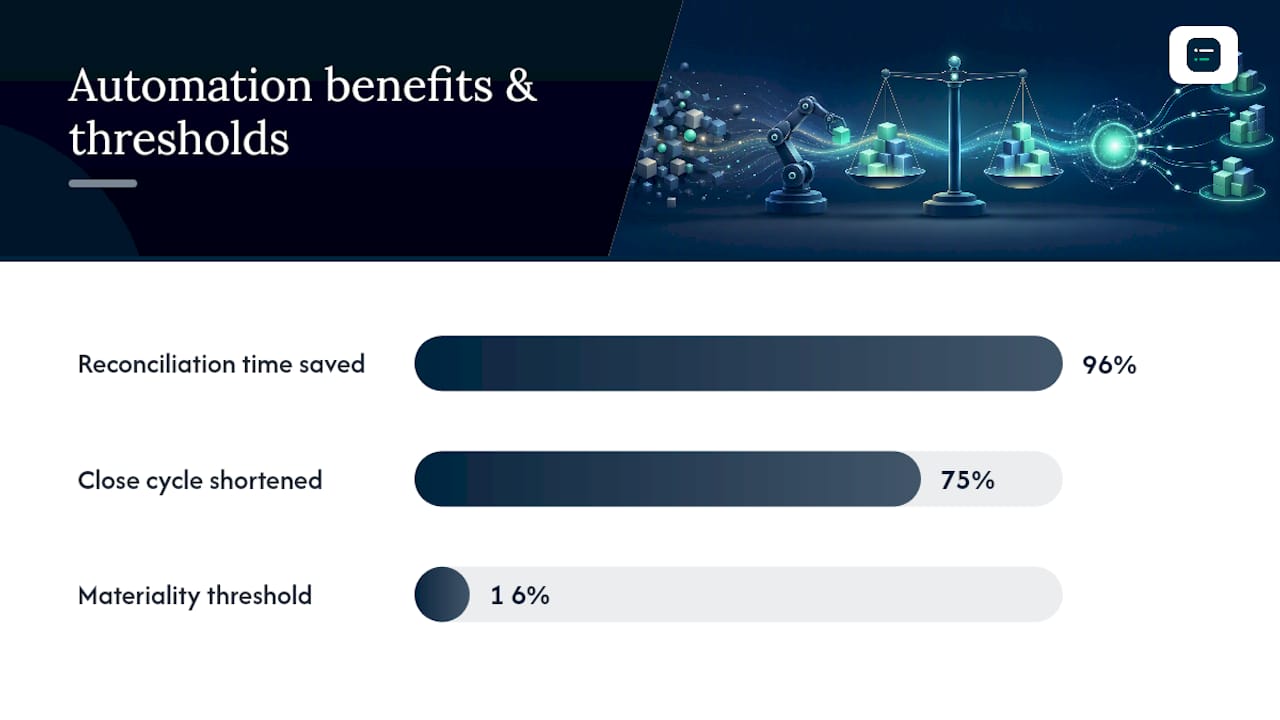
- What automation can and can't do for you
- Where to compare reconciliation tools
- What separates good reconciliation practice
- Sources
What balance sheet reconciliation is and why it matters
The process ties a general ledger account to something outside the ledger (a bank statement, a fixed asset register, an aged debtors report) so you can show the number on the balance sheet is real. When that tie-out does not happen, unreconciled items do not disappear. They roll forward month after month until they distort the balance sheet enough to cause a restatement or a difficult audit conversation.
The stakes reach beyond the finance team:
- Audit readiness: reconciliations show auditors quickly whether controls are working.
- Cash management: an unreconciled bank account can hide fraud, duplicate payments or simple timing errors.
- Reporting integrity: management, lenders and investors rely on balance sheet figures that have been checked, not just posted.
Skipping a reconciliation does not save time; it moves the work to a later point when it is harder and more visible.
Which accounts to prioritise and how often to check them
Not every account needs the same attention. A tiered approach works better: rank accounts by risk and reconcile the riskiest most often. Stanford's finance office, for example, sets reconciliation frequency by weighing "risk, materiality and history" (Stanford Fingate).
High-risk accounts that belong in your top tier include:
- Cash and bank accounts
- Intercompany balances
- Accruals and provisions
- Inventory
- Fixed assets
- Payroll liabilities
- Tax accounts
- Deferred income
- Loans and other debt
A practical Tier 1/2/3 cadence:
- Tier 1 (monthly, high risk): cash, intercompany, payroll liabilities, tax accounts. Sage suggests reconciling cash daily or weekly where volumes are high.
- Tier 2 (monthly or quarterly, moderate risk): prepayments, accruals, inventory.
- Tier 3 (quarterly or half-yearly, low risk): low-activity or immaterial balances that rarely move.
Set a materiality threshold for investigating differences, usually a mix of a percentage of the balance and a fixed minimum, so small accounts are not chased over pennies. Agree the levels with the client or your firm's policy rather than borrowing someone else's.
!Which accounts to prioritise and how often to check them, overview diagram
The six-step reconciliation process and work paper checklist
A reconciliation is only as good as the sequence behind it. The same six steps every time give you something repeatable, which is what reviewers and auditors trust.
- Lock the period. Confirm the cut-off date and stop new postings to the account until the reconciliation is complete.
- Extract the GL balance. Pull the exact ending balance at that cut-off.
- Obtain the supporting source. Gather the bank statement, sub-ledger report, asset register or third-party confirmation for the same date.
- Compare the two balances. Identify the difference, however small.
- List and age reconciling items. Every difference gets a line: description, amount, date it arose and an owner.
- Investigate, post corrections and document. Correct genuine errors with journal entries, note timing differences separately, and write down what you found.
Then a reviewer who was not involved in preparing it signs off. Sage recommends a second person reviews and approves reconciliations where possible, and segregating recording, reconciling and approving adjustments. People are poor at spotting their own mistakes.
Your reconciliation cover sheet should include:
- Account name, number and owner
- GL balance and supporting balance, side by side
- A table of reconciling items with dates and named owners
- Evidence attached (bank statement PDF, asset register export, confirmation email)
- Preparer sign-off and reviewer sign-off, both dated
Give every open item an owner, set an escalation point (for example, anything still open at the next month end), and keep evidence of how it was resolved, not just a note that it was "fixed".
Tip: _Build the cover sheet once, lock the layout, and reuse it for every account. A reviewer who sees the same structure each month spots oddities faster._
Real examples: cash, receivables, and fixed assets
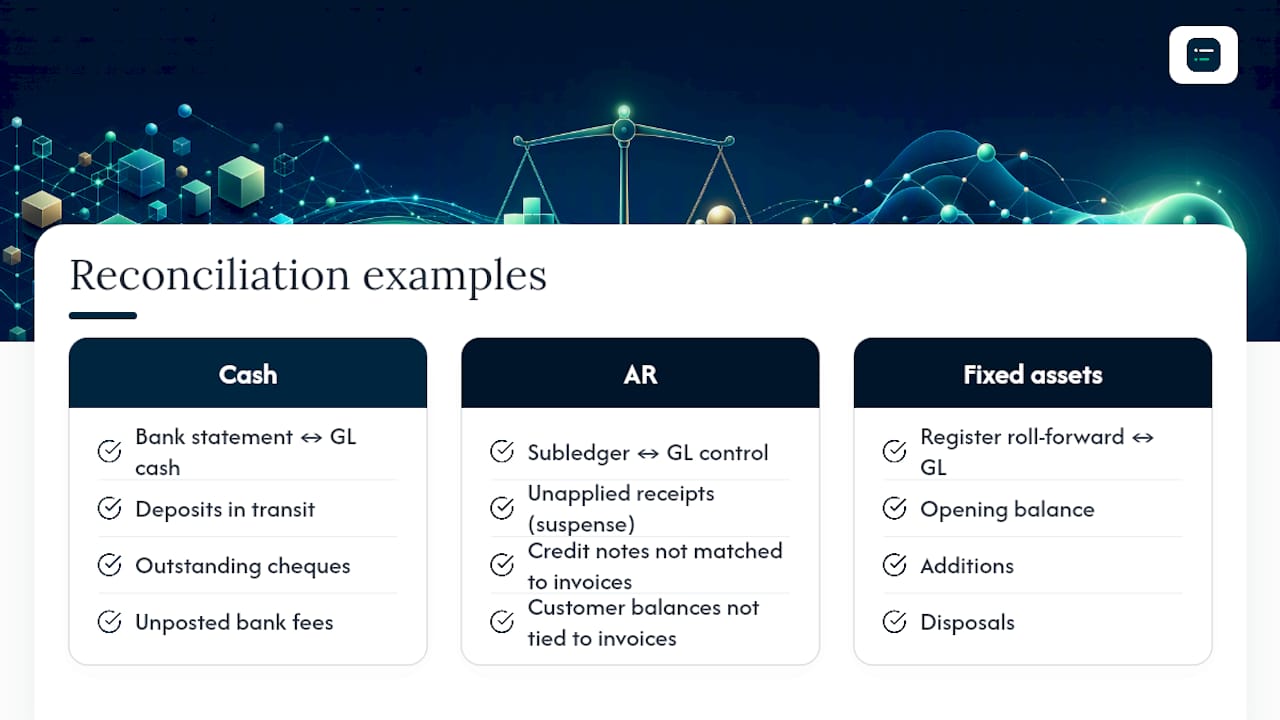
Cash tie-out. Compare the bank statement balance with the GL cash account. Common reconciling items include deposits in transit (recorded in your books but not yet cleared by the bank), unpresented cheques, bank charges not yet posted, and transactions processed after the cut-off.
Debtors roll-forward. Reconcile the sales ledger total to the GL control account. Watch for unapplied receipts sitting in suspense, credit notes not yet matched to invoices, and customer balances that do not tie to actual open invoices.
Fixed asset reconciliation. Roll the asset register forward: opening balance, plus additions, minus disposals, minus depreciation, plus or minus reclassifications, equals the closing GL balance. Differences here usually trace back to an asset added to the register but not posted to the GL, or a disposal recorded in one place and forgotten in the other.
!Three account reconciliation workflows compared
Where reconciliations go wrong
Most reconciliation failures are small gaps that build up.
- Stale reconciling items. An item that has sat unresolved for several months usually points to a bigger problem: missing paperwork, a dispute, or an error nobody wants to own.
- Offsetting errors. Two mistakes that cancel out can leave a balance looking clean while hiding real misstatements. Reviewers should check reconciling items individually, not just the net difference.
- Wrong-period data. Comparing a GL balance with a statement from the wrong cut-off date produces a false difference and wastes time chasing a problem that does not exist.
- Incomplete support. Missing or inconsistent evidence undermines a reconciliation even when the arithmetic is right.
Fixes work when they are specific: name an owner, set a date, and require evidence that the item closed.
Templates, sign-off, and the metrics that show you're improving
Consistency turns reconciliation from a monthly scramble into a predictable control. Sage recommends a standard template or consistent method so reconciliations are easier to follow and review, which means every account produces the same evidence trail whoever prepares it.
Keep preparer and reviewer roles separate. A reviewer's sign-off checklist should confirm:
- The cut-off date matches across GL and supporting evidence
- All reconciling items have dates, amounts and owners
- Support is attached and legible
- Aged items carry a plan to clear them, not just a note
Track a few health measures over time: the number of aged items, recurring exceptions on the same account, and post-close adjustments that trace back to a missed reconciliation. A rising trend in any of these is an early warning, well before an auditor finds it.
What automation can and can't do for you
Automation tools are strongest at high-volume, rules-based work: matching transactions, flagging exceptions, and alerting you when a previously reconciled balance moves. Some also offer drill-down to individual transactions and live connections to the ledger or ERP, which removes much of the manual chasing on Tier 1 accounts. For cash accounts specifically, see the bank reconciliation category.
The risk is a tool that matches quickly but with weak exception logic, producing a wrong reconciliation faster than a person would. Before adopting any tool, check its exception handling:
- Does it flag unmatched items clearly, or bury them?
- Can you see a full audit trail for every automated match?
- Does it connect to your actual ledger or ERP, or need manual exports?
Automation handles volume. It does not replace judgement on what a reconciling item means.
Where to compare reconciliation tools
The AI Ledger is an independent directory of 300+ AI tools for accountants and bookkeepers, each with an editor score, a verdict and a last verified date. Use the comparison page and the finder to shortlist tools against the exception-handling and audit-trail checklist above, or start from the month-end close category. Listings for reconciliation and close tools include BlackLine, Trintech, FloQast and Numeric. Our AI tool comparison guide) covers how to weigh them.

The free Friday newsletter covers new releases and price changes in plain English.
What separates good reconciliation practice
The teams that reconcile well are not the ones with the most expensive software. They do the routine upstream work, clearing suspense accounts, matching invoices promptly and filing bank statements when they arrive, so month-end reconciliation confirms the numbers rather than digging for them.
Tip: _Clear suspense and clearing accounts weekly rather than monthly, so they never build into a month-end backlog._
Sources
- Balance Sheet Account Balance Reconciliation, Stanford University Fingate (checked 20 November 2026)
- Step-by-step balance sheet reconciliation (with examples and best practices), Sage Advice UK, 18 March 2026
- How to reconcile balance sheet accounts: step-by-step, Equility
Recommended
- Common accounting workflow bottlenecks: your 2026 fix)
- Automation tools for multi-entity accounting: 2026 UK guide
- Why AI reduces accounting errors: a 2026 guide)
- AML automation for accountants: a practical adoption guide