What is a finance digital twin: guide for finance leaders
By The AI Ledger editorial team | Published 2026-08-11 | Updated 2026-11-20
A finance digital twin is a continuously synchronised virtual copy of your organisation's financial position that lets finance teams run governed what-if simulations against the current books. Unlike a static model or a spreadsheet scenario, it keeps a live connection to your core systems, so each simulation reflects today's position rather than last month's snapshot.
It is worth considering when a wrong assumption is costly and answers are needed quickly: intraday liquidity monitoring, stress testing, continuous scenario-based planning, and linking sustainability data to financial results.
Three components every finance leader should expect:
- Live data bond: real-time or near-real-time feeds from ERP, treasury, CRM and payments via change-data-capture (CDC) or event streaming
- Model layer: balance sheet, liquidity, portfolio and margin models that consume those feeds continuously
- Scenario engine: a governed, auditable layer for running what-if simulations and stress tests against the live model
Key takeaways
A finance digital twin is only a twin when a live data bond and continuous reconciliation keep the virtual model in step with the source systems; without both, it is a static simulation.
| Point | Details |
|---|---|
| Definition | A continuously synchronised virtual copy of your financial position, not a static model or a batch-refresh report. |
| Main business value | Faster scenario testing and continuous planning in place of point-in-time forecasting cycles. |
| Implementation priority | Start with one narrow use case; prove the data bond and reconciliation before building any model. |
| Governance | Appoint a model owner and an independent validator before build starts; log every scenario run from day one. |
| Finding tools | Use the directory and tool finder to identify planning, integration and automation tools for a pilot. |
Table of Contents
- How does a finance digital twin work technically?
- What business benefits does a finance digital twin deliver?
- What do you need before starting a finance digital twin?
- What drives the timeline and cost?
- What are the common pitfalls and governance requirements?
- How do vendor approaches compare?
- A practical checklist for your first pilot
- Security considerations for finance digital twins
- Where finance digital twins are being used
- Trends to watch
- Integration challenges with existing legacy systems
- Sources
How does a finance digital twin work technically?
A useful way to think about the architecture is in four layers: data integration, model, scenario engine, and decisioning/output. Working through each layer helps you judge technical feasibility before committing budget.
Data integration layer ingests transactions and state changes from ERP, treasury management systems, payment rails, CRM and trade systems. CDC captures row-level changes as they occur; event streams carry payment and trade events in near real time. The output is a continuous, ordered feed of financial facts.
Model layer holds the balance sheet, liquidity, portfolio and margin models. These consume the integration feed and maintain derived views of your financial position. A key pattern here is incremental view maintenance (IVM), which updates joins and aggregations as each new transaction arrives instead of recomputing everything on a schedule. That is the difference between a twin and a nightly batch refresh.
Scenario engine sits above the model layer and lets finance teams run parameterised simulations: shift a funding rate, remove a counterparty, apply a regulatory shock. SAP frames this as a flight simulator for FP&A, where teams see the impact on P&L, balance sheet and cash flow instead of debating assumptions in slide decks.
Decisioning and output layer delivers role-based dashboards, alerts and audit trails. Every simulation run should be versioned and logged, which regulated UK firms will need for model governance.
Key technology patterns to know:
- CDC and event streaming (Apache Kafka, AWS Kinesis or equivalent) for fresh data
- Graph or semantic models for representing relationships across legal entities and counterparties
- Reconciliation and drift checking to detect when the virtual model diverges from the source systems
- Role-based access and audit trails for compliance and model governance
Very fresh data is achievable but needs deliberate infrastructure choices. Concurrency matters too: several users running stress scenarios at once must not slow the live feeds other systems depend on.
Before you build a model, measure how fresh your data actually is. Check the lag between a transaction posting in your ERP or treasury system and it appearing in the feed, and compare it with what your use case needs. If the gap is large, fix the integration layer first. A sophisticated model on a slow feed is still a batch system.
| Layer | Primary inputs | Key pattern | Output |
|---|---|---|---|
| Data integration | ERP, treasury, payments, CRM | CDC, event streaming | Ordered transaction feed |
| Model layer | Integration feed | IVM, graph models | Live financial position views |
| Scenario engine | Model layer + parameters | Parameterised simulation | What-if P&L, balance sheet, cash flow |
| Decisioning/output | Scenario engine | Role-based dashboards, audit logs | Decisions, alerts, regulatory reports |
What business benefits does a finance digital twin deliver?
The clearest benefit is speed. Instead of building scenarios in spreadsheets, reconciling versions and presenting assumptions, finance teams run a governed simulation against the current position. That shortens the time between a business event and a financial decision.
Benefits to expect:
- Faster scenario testing without manual reconciliation between model and actuals
- Continuous planning in place of point-in-time forecasting cycles
- Closer alignment between operational data and financial outcomes
- Fewer disconnected spreadsheet models, since one governed twin replaces several
- Cleaner audit trails for regulatory submissions and internal governance
The strongest use cases tend to involve liquidity, risk and sustainability, where a continuously queryable view of complex relationships is hard to get from batch systems.
BCG describes a digital financial twin that lets companies compare financial KPIs such as profitability with non-financial KPIs such as CO2 emissions across a product's whole life. For UK finance teams preparing for more detailed sustainability reporting, that gives FP&A a structured way to connect sustainability data to financial results.
Pricing and margin simulations benefit from the same live data. When cost inputs change, the twin shows the margin impact straight away rather than after the monthly close. For treasury teams, an intraday cash view that updates as payments settle can replace the morning spreadsheet.
What do you need before starting a finance digital twin?
Readiness matters more than ambition. Teams that skip the prerequisites tend to spend the early phase fixing data problems rather than running scenarios.
Preconditions to confirm before you start:
- Clean, mapped master data across legal entities, cost centres and counterparties
- Event streaming or CDC capability on your ERP and treasury systems, or a credible plan to add it
- A named model owner with authority over model governance and versioning
- A cross-functional skills mix: finance analysts who understand the business drivers, data engineers who can build and maintain the pipelines, and a platform architect who can design for scale and auditability
- Agreed acceptance criteria for what "correct" looks like in the model, set before build starts
Stepwise implementation path:
- Select a narrow pilot use case: intraday cash positioning or a single stress-test scenario works well. Avoid starting with a full balance sheet twin.
- Validate streaming and reconciliation before writing a model. Confirm the integration layer can deliver the freshness your use case needs.
- Build a lean model covering only the entities and relationships the pilot needs.
- Run scenarios with the finance team taking part, rather than handing them a dashboard.
- Expand step by step, adding use cases and data sources as the governance framework matures.
Treat the twin as an operational architecture project rather than a reporting project.
| Dimension | Pilot | Production (one use case) | Enterprise roll-out |
|---|---|---|---|
| Best for | Proof of concept, single use case | One high-value workflow | Multi-entity, multi-use case |
| Data integration complexity | Low to medium | Medium | High |
| Implementation effort | Small team, contained scope | Dedicated squad | Programme-level resource |
| Deployment model | Cloud (managed services) | Cloud or private | Cloud or private, often hybrid |
Appoint your model validator before your model builder. Independent validation is much harder to retrofit than to build in. For banks and building societies with internal model approval, the PRA's SS1/23 model risk management principles include independent model validation as one of five principles.
Accounting software integration patterns) are useful groundwork here, since the ERP and payment connections that feed a twin are the same ones your finance automation already depends on.
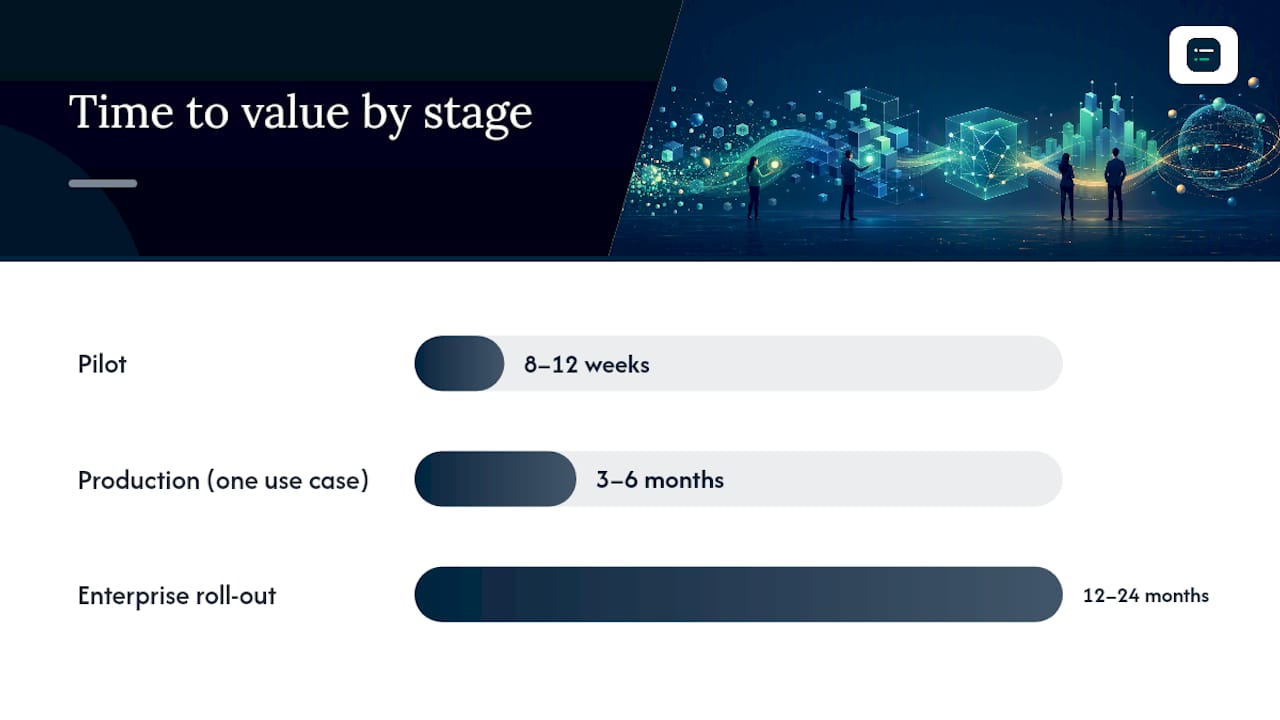
!What do you need before starting a finance digital twin?, overview diagram
What drives the timeline and cost?
There is no standard timeline. Size each stage against your own systems and data:
- Pilot: one use case, contained data scope, small team. The goal is to prove the data bond and run one governed scenario.
- Initial production twin: one use case in production, a full governance framework, integration with one or two core systems.
- Enterprise roll-out: multiple entities and use cases, with full integration across ERP, treasury, CRM and trade systems.
Data integration effort usually sets the pace more than model complexity. Teams with CDC infrastructure and clean master data move faster. Those starting from a batch-oriented ERP with fragmented entity data spend the first phase on plumbing.
Primary cost drivers:
- Data integration engineering: building and maintaining live feeds from legacy systems
- Model engineering: finance analysts and data engineers working together on model design and validation
- Validation and testing: independent validation, reconciliation testing and scenario acceptance testing
- Infrastructure: cloud managed services are quicker to start; private deployment costs more upfront but may be required for data residency
- Ongoing operating cost: live feeds need monitoring, alerting and recalibration as source systems change
A narrow pilot gets you to a result sooner. Intraday liquidity for a single legal entity is a better pilot than a group-level planning twin. The finance automation metrics you set for the pilot should be measurable within the pilot, not dependent on a full roll-out.
What are the common pitfalls and governance requirements?
The most common mistake is calling a static model a twin. The label only fits when continuous data feeds keep the virtual model in step with the source systems. A nightly batch refresh is not a twin, however it is marketed.
Common pitfalls:
- Scope creep in the pilot: adding use cases before the data bond is proven
- Poor data lineage: no clear record of where each model input comes from and when it was last updated
- Model drift: the model's assumptions move away from the real system over time without anyone noticing
- Insufficient reconciliation: no automated check that the twin's outputs match the source systems within an agreed tolerance
- Governance by committee: too many people with sign-off authority and no single model owner
Governance checklist for UK finance leaders:
- Assign a named model owner with documented accountability
- Put all model definitions and parameter sets under version control
- Run continuous automated reconciliation between twin outputs and source system actuals, with a defined tolerance so drift is caught early
- Validate any model independently before it is used for regulatory reporting or capital allocation decisions
- Keep a full audit trail of every scenario run: who ran it, which parameters were used, what outputs were produced
- Review model assumptions quarterly or after any material change to the business
For banks and building societies in scope, the PRA's SS1/23 sets out how models used for risk and capital decisions should be governed, and a twin used for those purposes falls within it. Data residency requirements may also limit your deployment options if the twin processes personal or commercially sensitive data.
How do vendor approaches compare?
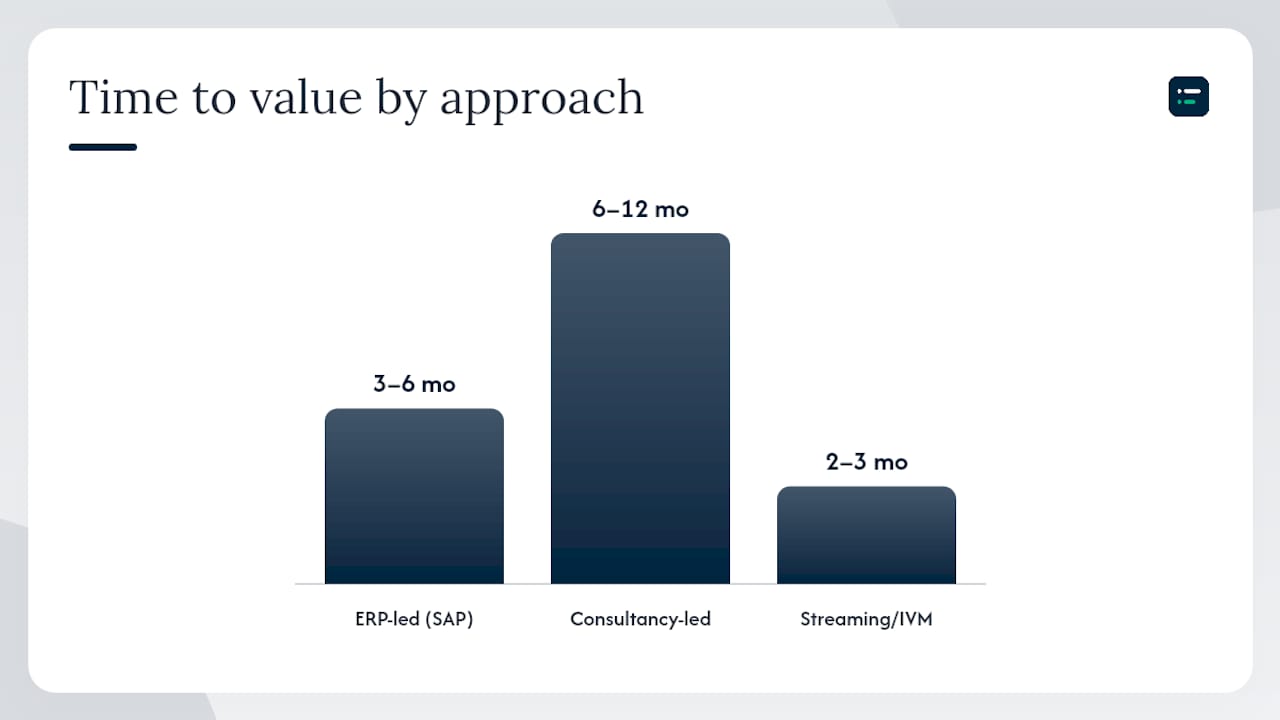
No single vendor owns this space. The practical choice is between three broad approaches, each with different trade-offs on integration complexity, effort and cost.
ERP-led assembly (SAP and similar): SAP positions its FP&A and analytics platform as the basis for a financial digital twin. The advantage is tight integration with SAP ERP data; the constraint is that organisations on other stacks face more integration work. Best suited to large enterprises already standardised on SAP.
Consultancy-led transformation (BCG and similar): BCG approaches the digital financial twin as a strategic programme that connects financial and non-financial data. This suits organisations that need programme-level change management alongside the technology. Expect a longer route to value and a more deeply embedded result.
Streaming databases with incremental view maintenance (Materialize and similar): built for keeping complex views up to date as data changes, which is the live data bond problem. Best suited to organisations with strong data engineering capability that want to build a custom twin rather than buy a packaged one. Quicker to a working prototype, but it needs more internal expertise to run.
| Approach | Best for | Data integration complexity | Implementation effort | Deployment model |
|---|---|---|---|---|
| ERP-led (e.g. SAP) | Large enterprises on SAP stack | Low within SAP; high outside it | High; requires SAP expertise | Cloud or private |
| Consultancy-led (e.g. BCG) | Enterprise transformation programmes | High; full data architecture work | Very high; programme-level | Varies by client |
| Streaming/IVM database (e.g. Materialize) | Data-engineering-led custom builds | Medium; requires pipeline expertise | Medium; needs internal engineers | Cloud-native |
Smaller finance teams that want scenario planning without building a twin can start with an FP&A platform. Examples in our directory include Anaplan, Pigment, Planful, Vena and Datarails. For AI-enabled scenario modelling) on top of a twin, the vendor at the model layer matters less than the quality of the data feeding it.
!How do vendor approaches compare?, overview diagram
A practical checklist for your first pilot
Getting started does not need a full programme. A focused pilot with a narrow scope can produce a working proof of concept.
Pilot readiness checklist:
- Pick one use case with a measurable outcome: intraday cash positioning, a single stress-test scenario, or a margin simulation for one product line
- Confirm live data feeds exist for the systems that use case needs; do not assume CDC is in place
- Appoint a model owner and a separate model validator before build starts
- Secure a small cross-functional team: a finance analyst, a data engineer and a platform architect
- Define success measures in advance: what does "correct" look like, and how will you check it?
- Run your reconciliation checks before your first stress scenario. Confirm freshness and tolerance thresholds first, then stress test.
Further reading:
- SAP community post on reinventing FP&A with a financial digital twin, strategy and FP&A framing
- BCG on why companies need digital financial twins, financial and non-financial KPIs
- PRA SS1/23 model risk management principles, governance and independent validation
Security considerations for finance digital twins
A finance digital twin concentrates sensitive data in one place and keeps it continuously updated, which makes it an attractive target. Build security into the architecture from the start.
The live data feeds are the main attack surface. CDC feeds and event streams carry transaction-level financial data in near real time. Interception or tampering with those feeds corrupts the twin's outputs, possibly without an obvious alert. Encrypt feeds in transit and at rest, and require strict authentication on every producer and consumer.
Role-based access on the scenario engine matters as much as perimeter security. Not every finance user should be able to run any stress scenario against live capital positions. Setting scenario permissions by role, and logging every run with the user and parameters, limits both accidental misuse and deliberate manipulation.
For UK firms, data residency is a practical constraint. If the twin processes personal data covered by UK GDPR, the deployment must keep that data within approved boundaries. With cloud deployments, confirm in writing where the data is held and processed.
Governance and security meet at the audit trail. A twin used for regulatory reporting must produce outputs an auditor can trace back to the source data and the model version that produced them. That traceability also makes tampering detectable.
Where finance digital twins are being used
BCG's work on digital financial twins describes companies comparing profitability with non-financial measures such as CO2 emissions across a product's life, data that was previously held in separate systems with no financial link.
In treasury, the intraday liquidity use case is about replacing a morning aggregation of cash positions from several systems with a live view across legal entities and currencies that updates as payments settle.
SAP's FP&A framing shows a different pattern: finance teams replacing rounds of spreadsheet builds and assumption debates with scenario runs against a shared, governed model. When everyone runs scenarios against the same model, the discussion moves from whose numbers are right to what to do next.
Fraud detection in financial services can also benefit, because anomaly detection then runs against current transaction patterns rather than a batch snapshot that may be hours old.
Trends to watch
Graph-based semantic models are being used to represent multi-entity structures, intercompany flows and counterparty networks, which suits the model layer of a twin.
Generative AI is starting to appear as a scenario-generation layer. Instead of an analyst setting up each stress test by hand, an AI assistant proposes scenarios based on current conditions and the organisation's risk exposures, and the twin provides the governed data to run them against. For a wider view, see the role of AI in financial operations).
Sustainability reporting is becoming more detailed and more auditable, which makes a single governed model that connects supplier-level emissions data to financial results more useful.
Model risk management is also getting more attention. The PRA's SS1/23 treats model risk as a risk discipline in its own right, and a twin with full audit trails and independent validation is better placed for that scrutiny than a set of spreadsheet models without version control.
Integration challenges with existing legacy systems
Legacy ERP and treasury systems were not designed for continuous data extraction. Most expose data through batch exports, scheduled reports or overnight feeds. A live data bond on top of that needs either a CDC layer that reads the database transaction log, or re-engineering of how the source system exposes data.
CDC needs database-level access that many finance teams do not control. The ERP is often run by IT or a managed service provider, and getting approval to attach a log reader can take a long time. Start the conversation with IT early and frame it as a data access project.
Data quality in legacy systems is the second constraint. Duplicate cost centres, inconsistent legal entity codes and unmapped intercompany relationships show up as soon as you try to build one model across systems. Plan a data quality sprint before the pilot.
Multi-entity structures add complexity. A group whose legal entities each run a slightly different ERP configuration needs entity-level mapping before the twin can produce a consolidated view. Automation tools for multi-entity accounting handle some of this mapping, and the patterns they use apply to the integration layer of a twin.
The systems that feed a twin also change. A payment system upgrade, an ERP migration or a new CRM can break the data feed without warning. Automated reconciliation and alerting in the integration layer is how you catch those breaks before they corrupt the model.
FP&A should lead this, with IT as a partner
The value of a twin comes from finance teams who understand the business drivers well enough to define the right models, scenarios and acceptance criteria. FP&A understands the links between operational decisions and financial outcomes, which is what the model layer needs to encode. The first governance actions are simple: name a model owner, agree acceptance criteria before build starts, and plan independent validation from day one.
Finding tools for your pilot
A twin connects many parts: ERP integrations, data pipelines, reconciliation tools and scenario engines. The AI Ledger directory lists 300+ independently reviewed AI tools for accountants and finance teams, each with an editor score, a verdict and a last verified date. Use the tool finder to match tools to your tasks, or browse reporting and dashboards and month-end close. Editor scores are never for sale. The free weekly newsletter covers new tools, feature changes and pricing updates.
Sources
- From spreadsheets to a financial digital twin: reinventing FP&A with SAP
- Why companies need digital financial twins, BCG
- Model risk management principles for banks (SS1/23), Prudential Regulation Authority
- Materialize
Recommended
- Role of AI in financial operations: 2026 guide)
- Automated financial reporting: a guide for finance teams)
- Finance automation metrics to track in 2026
- Automated accrual accounting: a 2026 guide for finance teams)