AI lease accounting automation: a 2026 guide for finance teams
By The AI Ledger editorial team | Published 2026-07-09 | Updated 2026-11-20
AI lease accounting automation is the use of artificial intelligence to extract, classify and report lease data under standards including ASC 842, IFRS 16, GASB 87 and FRS 102, replacing manual abstraction and spreadsheet calculations. Current tools combine large language models and vision models to read long, inconsistent lease documents and produce structured, audit-ready data. For finance teams with dozens or hundreds of leases, the practical change is from weeks of manual abstraction to supervised processing with a human review step.
For UK teams the timing matters. The FRC's Periodic Review 2024 amendments to FRS 102 apply mainly to accounting periods beginning on or after 1 January 2026, and the new Section 20 removes the operating and finance lease distinction for lessees, so most leases now go on the balance sheet. Many UK companies are building their first full lease register this year.
- * *
What is AI lease accounting automation and how does it work?
AI lease accounting automation covers two connected phases: lease abstraction and lease accounting. Abstraction means reading a lease and pulling out the data points that matter, such as commencement dates, payment schedules, renewal options and responsibility splits. Accounting takes that structured data and applies the right treatment under whichever standard applies to your organisation.
!Person extracting lease data from documents

Some AI systems handle multi-page lease bundles without templates, using language and vision models to extract structured data directly. Lease documents vary widely in layout and language, so a system that needs a template for each landlord's format saves less time than it first appears.
The output feeds a lease accounting platform, which calculates right-of-use assets, lease liabilities and the journal entries. Good platforms update the calculations when a lease is amended or renewed, so the lease register stays current rather than going stale between audits.
- * *
How does AI reduce the manual workload in lease processing?
Extend, a document-processing vendor, estimates that manually processing 500 leases takes 125 to 250 hours, against 2 to 4 hours with automated processing. That is a vendor estimate, and it excludes the human review time you should still budget for.
The time savings come from several capabilities:
- Document ingestion at scale. AI reads PDFs and scanned images without manual keying, processing many leases in parallel.
- Automatic data extraction. Key fields including rent amounts, escalation clauses, lease terms and break options are extracted and mapped to a structured schema.
- Anomaly flagging. AI can scan full transaction populations rather than samples, surfacing unusual entries for human review.
- Audit trail creation. Each extracted field is logged with its source location in the original document, so audit queries are easier to answer.
- Amendment handling. When a lease is modified, the system reruns the calculations rather than needing a manual rebuild.
Validate AI outputs against what you already know about your portfolio before going live. If rent per square foot normally sits in a predictable range, flag any extraction that falls outside it so misreads are caught before they reach the trial balance.
!Infographic depicting lease accounting automation steps
- * *
Why AI lease accounting needs a human in the loop
AI lease accounting automation does not remove the need for lease expertise. Lease documents contain ambiguous language, unusual responsibility splits and clauses that need interpretation rather than extraction. AI handles the routine cases well; the edge cases still need a qualified person.
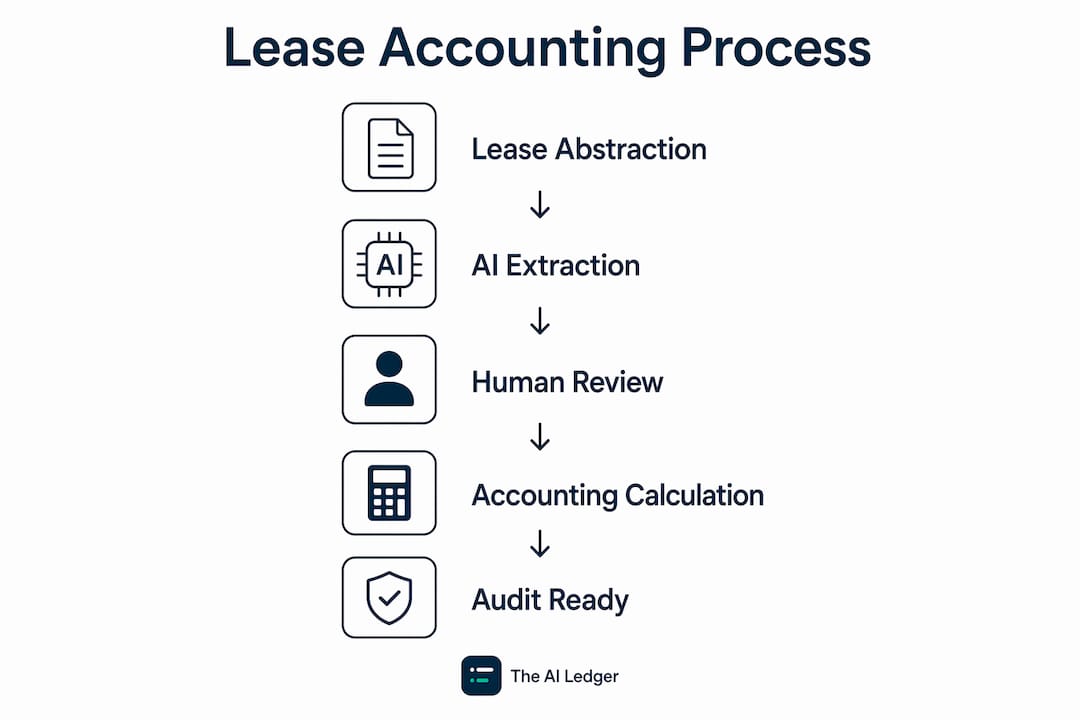
Some vendors, such as Visual Lease, describe AI abstraction built on prompts and validation checks designed by lease specialists. The workflow typically runs like this:
- The AI reads the lease and extracts all relevant fields.
- Each extraction gets a confidence score based on the clarity of the source text.
- Low-confidence extractions go to a review queue before the data enters production.
- A qualified reviewer checks flagged items, corrects errors and approves the record.
- The approved data feeds the lease accounting platform for the compliance calculations.
Where errors affect the financial statements, this review step is the right design rather than a workaround. No AI system should make final accounting decisions on ambiguous lease language without human sign-off.
Set review thresholds by document type. If you hold many ground leases or subleases, use stricter confidence thresholds for those. The AI will flag more items, but fewer errors will get through.
- * *
Key features of AI lease accounting platforms
Compliance coverage comes first. Trullion's lease accounting software guide describes both Trullion and LeaseQuery as handling ASC 842, IFRS 16, GASB 87 and FRS 102. For UK entities, check specifically that a platform supports the new FRS 102 Section 20, including its wider low-value exemption, not only IFRS 16.
Beyond compliance, look for:
- Configurable validation rules. Custom checks against your own benchmarks for rent, floor area and tenant allowances, to catch misreads before they reach the ledger.
- Automated journal entries. Correct entries for each lease event, including commencement, payment, modification and termination.
- Document classification. Separating leases from licences, service contracts and other agreements that do not go on the balance sheet.
- Lease grouping. Tools to group large numbers of low-value leases and reduce the number of individual calculations.
- Amendment and reassessment workflows. Automatic recalculation of the right-of-use asset and lease liability when terms change.
| Feature | Benefit |
|---|---|
| Multi-standard compliance engine | Supports ASC 842, IFRS 16, GASB 87 and FRS 102 from a single data set |
| Automated journal entries | Removes manual posting errors and speeds up month-end close |
| Configurable validation rules | Catches extraction anomalies before they affect financial statements |
| Document classification | Identifies which contracts qualify as leases under each standard |
| Amendment handling | Recalculates liabilities when lease terms change |
Some implementations separate the abstraction and accounting phases, pairing a specialist AI abstraction tool with a dedicated lease accounting platform. Others prefer one platform that does both. The trade-off is depth in each phase against one fewer integration.
- * *
Best practices for implementing AI lease accounting automation
Implementation depends more on data preparation than on the technology. Teams that go live with a poorly organised lease portfolio find the AI surfaces problems they did not know about, which is useful but creates remediation work.
- Audit your lease inventory first. Know how many leases you have, what formats they are in and which have been amended since signing.
- Apply sanity checks for rent, floor area and allowances during extraction, so misreads are caught before they reach your accounting system.
- Finish review before posting. Complete the AI extraction and human review cycle before feeding data into the compliance platform. Mixing the two phases creates reconciliation problems.
- Review anomaly flags regularly. Build a routine for working through flags rather than treating them as noise.
- Plan for amendments. Lease portfolios change. Set a clear process for feeding amendments back through abstraction and validation.
- Check covenants. The FRC's explainer for users of financial statements notes that bringing leases on balance sheet can shift gearing, interest cover and covenant calculations. Give your bank or lenders notice early.
Portfolios with legacy leases in non-standard formats will take longer to implement, so budget for that.
Do not switch off your existing accounting workflow processes) the day the AI goes live. Run both in parallel for at least one reporting period to surface discrepancies before you rely on the new system.
- * *
Key takeaways
| Point | Details |
|---|---|
| FRS 102 changes the workload | From periods beginning on or after 1 January 2026, most UK lessee leases go on the balance sheet. |
| Processing time drops | One vendor estimates 125 to 250 manual hours for 500 leases against 2 to 4 hours automated, before review time. |
| Human review stays | Ambiguous clauses still need someone who knows the standards. |
| Check standard coverage | Confirm support for FRS 102 Section 20 as well as IFRS 16 and ASC 842. |
| Data quality determines outcomes | Sanity checks against rent and floor-area benchmarks stop errors reaching the ledger. |
- * *
Where AI lease accounting is heading
AI handles the repetitive parts of lease accounting well: reading documents, keying data and rerunning schedules. It does not handle the hard parts, such as complex lease language, unusual structures and judgement on what counts as a lease. The teams that get most from these tools use the time saved to analyse the portfolio, model renewal scenarios and advise on lease versus buy, a move from data entry to advisory work that Intuit also describes.
Adopt with a plan to train your team to interpret and check AI output. Teams that expect full autonomy will be disappointed. The finder can help you shortlist platforms for your portfolio size and the standards you report under.
- * *
Lease accounting tools on The AI Ledger
The AI Ledger directory lists 300+ AI tools for accounting work. For lease accounting specifically:
- The Crunchafi Lease Accounting listing covers lease accounting under ASC 842, IFRS 16, FRS 102 Section 20 and GASB, with AI lease abstraction.
- The Trullion listing covers its audit, lease and revenue accounting platform.
For close tools that sit around the lease schedule, see the month-end close category, or compare tools side by side.
- * *
Frequently asked questions
What is AI lease accounting automation?
The use of AI, including language and vision models, to extract lease data from documents and apply the calculations required by standards such as FRS 102, IFRS 16 and ASC 842, replacing manual abstraction and data entry.
How much time does AI save in lease processing?
Extend, a vendor, estimates 125 to 250 hours to process 500 leases manually against 2 to 4 hours automated. Add time for human review of flagged items, and test on a sample of your own leases before relying on any estimate.
Does AI replace lease accountants?
No. AI speeds up extraction and calculation, but complex lease clauses still need expert interpretation and sign-off.
What changed for UK lease accounting in 2026?
The FRC's Periodic Review 2024 amendments to FRS 102 apply mainly to periods beginning on or after 1 January 2026. Lessees no longer split operating and finance leases, so most leases are recognised on the balance sheet as a right-of-use asset and lease liability. Lessor accounting is largely unchanged.
Which compliance standards do AI lease platforms support?
It varies by vendor. Several, including Trullion and LeaseQuery, state support for ASC 842, IFRS 16, GASB 87 and FRS 102. Check FRS 102 Section 20 support specifically if you report under UK GAAP.
What is the biggest risk when implementing AI lease accounting automation?
Poor input data. Teams that skip sanity checks against rent and floor-area benchmarks let AI misreads reach the ledger, and those errors are costly to unwind.
Sources
- FRC, FRC revises UK and Ireland accounting standards (FRS 102 amendments, effective date)
- FRC, FRS 102 explainer for users of financial statements (Section 20 leases, covenants)
- Extend, How to process leases automatically (125 to 250 hours vs 2 to 4 hours for 500 leases, vendor estimate)
- Trullion, Lease accounting software solutions for ASC 842 and IFRS 16 (standards coverage)
- Visual Lease, AI lease abstraction
Recommended
- What is autonomous accounting: a 2026 guide for professionals)
- Grow your bookkeeping practice with automation)
- How to build accounting workflow templates in 2026)
- Finance automation metrics to track in 2026