AI in accounting explained: machine learning, NLP and agents (2026 guide)
By The AI Ledger editorial team | Published 2026-07-07 | Updated 2026-11-20
AI in accounting means software that learns from financial data and documents, applies rules at volume and hands the exceptions to a person. In a practice that mostly looks like reading invoices and receipts, coding transactions, matching bank lines, drafting reports and flagging entries that look wrong. Most of it is built from three ideas: machine learning, natural language processing and, more recently, AI agents that carry out a sequence of steps on their own. This guide explains each one in plain terms, what the research says about time and accuracy, where AI still falls short, and how to start without creating new risks.
Use of AI is already widespread in finance. The 2026 Global AI in Financial Services Report from the Cambridge Centre for Alternative Finance found that 81% of the financial services firms it surveyed are adopting AI at some level, and 40% of industry respondents describe their adoption as advanced.
Contents
- What is machine learning in accounting?
- What is natural language processing in accounting?
- What is autonomous accounting?
- What does the research say about time saved?
- Does AI reduce accounting errors?
- What role does AI play in financial operations?
- Which accounting tasks suit AI, and which do not?
- What are the risks of AI in accounting?
- Why do accountants adopt AI tools?
- How should a practice start?
- Frequently asked questions
- Sources
What is machine learning in accounting?
Machine learning is software that learns patterns from historical data instead of following rules someone wrote by hand. In accounting, the historical data is usually your own ledger: thousands of past transactions already coded to the right account. Two families of technique do most of the work.
Supervised learning trains on labelled examples. Show a model enough past transactions tagged as "motor expenses" or "rent", and it learns to suggest the code for new ones. Regression, also supervised, predicts a number rather than a category, which is how ML-based cash flow and revenue forecasts work.
Unsupervised learning works without labels and looks for natural groupings. Its most useful accounting job is anomaly detection: flagging entries that sit outside the normal pattern for that supplier, amount or time of month, without anyone defining "abnormal" in advance.
| Technique | Typical accounting use | Why it suits the job |
|---|---|---|
| Supervised learning | Transaction coding, forecasting | Learns from the labelled history you already have |
| Unsupervised learning | Anomaly detection, client segmentation | Finds patterns without pre-labelled data |
| Decision trees | Risk scoring, compliance checks | The logic can be followed and explained |
| Neural networks | Document recognition, fraud signals | Handles complex, many-variable patterns |
Data quality decides whether any of this is useful. A model trained on duplicated entries, inconsistent category names ("Travel", "T&E", "Travel and subsistence") or mixed scales learns those faults and repeats them at volume. The Texas A&M data analytics for accounting text covers the preparation steps: remove duplicates, standardise labels, decide how to treat missing values and drop fields that add noise.
You do not need to code to use these tools. You do need to know what a confidence score means and when to overrule one. MIT Sloan's write-up of the Stanford and MIT study found that more experienced accountants got larger gains from AI, possibly because they were better at reading the system's confidence scores and stepping in when they were low.
What is natural language processing in accounting?
Natural language processing (NLP) is the part of AI that reads text. It turns unstructured documents, such as invoices, emails, bank narratives, contracts and board packs, into structured data. Strategic Finance, the IMA's magazine, describes it as letting firms process text far faster and more consistently than manual review.
A typical document pipeline has six steps:
- Ingest. PDFs, scans and emails arrive. Optical character recognition (OCR) turns scanned images into text.
- Pre-process. The text is split into words and phrases and its structure is identified.
- Extract. Named entity recognition picks out the supplier, invoice number, date, amount, VAT rate and payment terms.
- Enrich. The extracted supplier is linked to a nominal code, or a lease clause is tagged as a break option. MIT Sloan notes that this kind of tagging makes text searchable in ways keyword search misses.
- Verify. A person checks low-confidence extractions before anything is posted.
- Output. Structured records flow into Xero, QuickBooks, Sage or FreeAgent, or into an audit workpaper.
In a practice, NLP shows up in invoice and receipt capture (tools such as Dext, AutoEntry and Datamolino), in bank reconciliation, where it matches a narrative like "BACS PMT SMITH PLUMBING 14MAY" to an open invoice by meaning rather than an exact string, and in contract review, where it pulls rent review dates or IFRS 15 performance obligations into a register. Generative AI assistants are also NLP: they answer plain-English questions over a set of documents.
Accuracy on clean PDFs is usually far better than on poor scans or handwriting, so audit your document quality before a pilot. If the documents contain personal data, UK GDPR applies: you need a lawful basis, a data processing agreement with the vendor, data residency you are comfortable with and an entry in your record of processing. The ICO is the primary source, and our guide on whether it is safe to put client data into AI covers the practical checks.
What is autonomous accounting?
Autonomous accounting, also called agentic accounting, is the use of AI agents that carry out a whole workflow, such as matching an invoice to a purchase order, chasing the supplier for a corrected copy and preparing the posting, without a person starting each step. The difference from traditional automation is how exceptions are handled. Robotic process automation follows a fixed script and stops when the input changes. Agentic systems use reasoning to deal with some exceptions without being reprogrammed.
Accounting Today describes agents that contact vendors for corrected invoices and cancel invalid ones without a prompt. In practice the rhythm looks like this: agents process the overnight batch, the accountant arrives to a short exceptions queue, resolves the flagged items and approves the rest.
The accountant's responsibility does not move to the software. You still review exceptions, sign off and answer for the output. The most useful real example so far argues for less autonomy, not more. When Morgan Stanley built agents for P&L reconciliation, VentureBeat reported that a task taking up to six hours per book fell to two or three hours, about 1,500 hours a week across roughly 100 controllers. It got there by making the system less autonomous: humans review every recommendation, and decisions they repeat become fixed rules.
For a small practice, the sensible reading is to give agents narrow, high-volume, well-defined jobs first (supplier invoices, bank matching), build the review and audit trail before adding more, and widen their scope only when the exceptions queue shows they are reliable. Tools working in this area include Vic.ai, Docyt, Truewind and Digits.
What does the research say about time saved?
The best evidence for smaller firms comes from a study by Jung Ho Choi of Stanford Graduate School of Business and Chloe Xie of MIT Sloan, covering 79 small and mid-sized firms using AI accounting tools and a survey of 277 accountants.
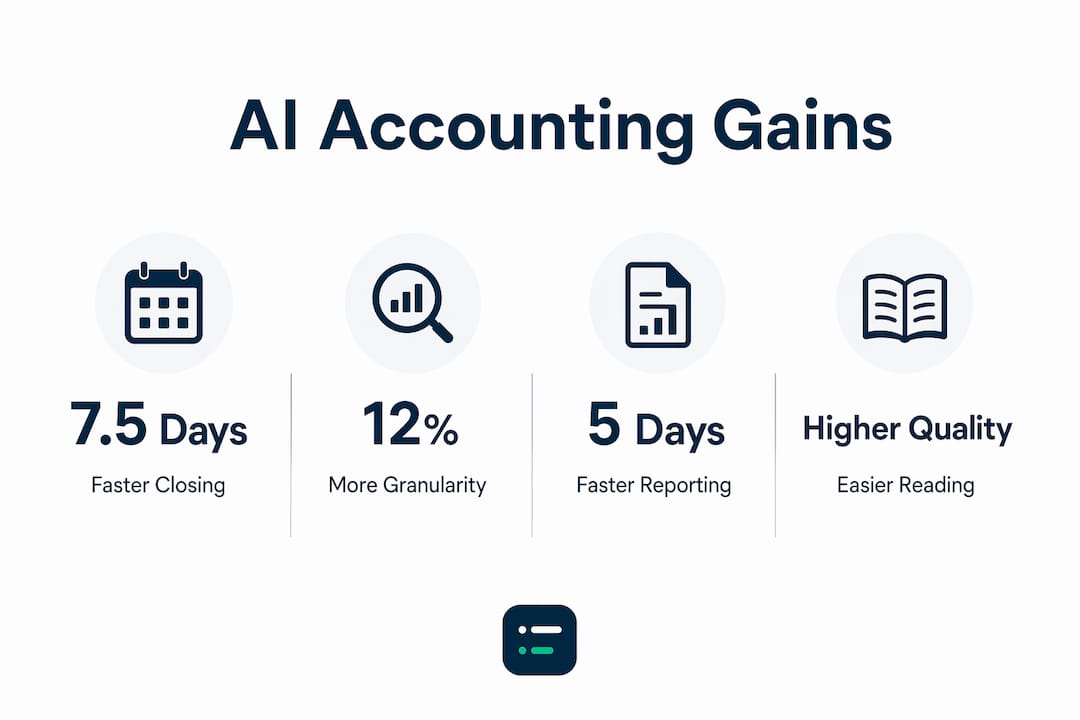
| Finding | Result | Source |
|---|---|---|
| Monthly statement preparation | About 7.5 days sooner | Choi and Xie, via AWSCPA |
| Routine back-office processing time | Down 8.5% | Same study |
| Detail in bookkeeping records | Up 12% | Same study |
| Annual report filing | About five days faster, and easier to read | UNC Kenan-Flagler |
The granularity result is easy to overlook: AI-assisted firms broke expenses into more detailed categories, which helps both audit readiness and client reporting. For tax, AWSCPA reports that the best US deployments automate more than 80% of the mechanical work of individual tax return preparation, with judgement calls and complex cases left to the preparer. That is US data on US returns, so treat it as a sign of direction for UK self assessment rather than a forecast.
!Infographic showing AI accounting efficiency gains
Does AI reduce accounting errors?
AI reduces accounting errors mainly in repetitive, high-volume steps: reading documents, coding transactions and matching bank lines. The QuickBooks 2025 survey cited here reported that 98% of respondents saw better accuracy after adopting automation, but it is a vendor survey of its own users, so treat it as a ceiling. The control that keeps errors out of a VAT return is still a person reviewing each posting.
The mechanism is simple. A rule applied by software is applied the same way on the five-hundredth invoice as on the first, while people get tired and make keying errors. Anomaly detection then looks at every transaction rather than a sample, so it can flag duplicate invoices, a supplier coded to an unusual account, payments at odd times or entries with no supporting document. Catching an error at posting is far cheaper than finding it at year end. Tools focused on this include MindBridge and Caseware Verity, listed in the audit and fraud detection category.
The flip side: a model that miscodes one transaction type will miscode it every time. The controls that make AI accuracy hold up are:
- Let the system auto-post only high-confidence, low-risk items.
- Route everything below a confidence threshold to a named reviewer.
- Sample-check a batch of auto-posted entries each month to catch drift.
- Log what the AI proposed, what the reviewer decided and why.
- Watch the exception rate. A rising rate means the model or the inputs have changed.
AWSCPA puts the risk well: AI can fail silently on edge cases, producing tidy output that is wrong, which is why an experienced reviewer stays in the loop.
What role does AI play in financial operations?
In a finance function, as opposed to a practice, AI sits across the systems rather than inside one of them: pulling ledger, payroll, procurement and bank data together, monitoring transactions continuously, running variance analysis and building forecasts and scenarios. Its main jobs are:
| Application | What AI does | What the person does |
|---|---|---|
| Continuous monitoring | Scans transactions and flags anomalies as they post | Investigates and resolves alerts |
| Document extraction | Reads invoices, receipts and statements and maps them to accounts | Reviews exceptions |
| Variance analysis and reporting | Drafts commentary and management packs | Checks the numbers and the story |
| Forecasting and scenarios | Runs several projections from live data | Tests the assumptions and decides |
The KPMG Global AI in Finance Report 2026, a survey of 1,013 senior finance leaders at large companies in 20 countries, found that respondents rated decision-making quality (70%) and decision speed (71%) among the biggest gains, and that the strongest results came from aiming AI at judgement-heavy work rather than pure transaction processing. These are firms with revenue of US$250 million or more, so read it as direction of travel rather than a benchmark for a small practice.
The precondition is clean, joined-up data. BCG points to a unified chart of accounts as the base layer: if each entity codes things differently, AI cannot reason across them. Practical steps are a consistent chart of accounts, API connections between the ledger and other systems, data lineage so every output can be traced to source records, and a clear rule on who may approve AI-generated outputs. For tools in this area, see the reporting and dashboards and month-end close categories, including Fathom, Numeric and Puzzle. Our guide to automated financial reporting) goes further.
Which accounting tasks suit AI, and which do not?
AI does best where volume is high and the rules are clear. It does worst where the answer depends on judgement, context or thin data.
| Good fit now | Still needs a person in charge |
|---|---|
| Bank reconciliation and matching (category) | External audit opinions |
| Invoice and receipt capture (category) | Tax planning and interpretation |
| Expense coding and categorisation | Business valuation |
| Data gathering for tax returns (category) | Complex multi-entity consolidations |
| Anomaly and duplicate flagging | Client advice and difficult conversations |
| First drafts of reports and client emails | Anything you sign |
For tax research, tools such as Blue J can speed up finding the relevant law, but AWSCPA warns that language models sometimes produce confident but incorrect citations, so every reference needs checking. Our page on what AI can and cannot do in an accounting practice sets out the limits in more detail.
What are the risks of AI in accounting?
The Cambridge report found that 74% of industry respondents named data privacy and protection as a top risk, and 70% named hallucinations and unreliable outputs (CCAF, 2026). Those are the two risks to plan for first.
- Unreliable outputs. Build a review step before any AI output reaches a client, HMRC or Companies House.
- Poor integration. AI produces wrong outputs when it is not properly connected to the ledger or ERP, and it can do so with apparent confidence. Avoid tools that only work on exported spreadsheets.
- Data protection. Check the vendor's data processing agreement, where data is held and whether client data is used to train models, against ICO guidance.
- Accountability gaps. Name who reviews and approves AI-assisted work. Research on human-AI finance stresses allocating authority, oversight and accountability explicitly.
- Skills lag. Tools underperform when staff do not understand their outputs, so train alongside the rollout.
On jobs, the evidence so far points to roles changing rather than disappearing: less keying and first-pass processing, more exception review, oversight and advice. We cover that question separately in will AI replace accountants by 2027?
Why do accountants adopt AI tools?
Mostly to get time back. The Choi and Xie results above, with monthly statements about 7.5 days sooner and more detailed records, are the clearest published reasons for a small practice. The other reasons are capacity (taking on more clients without hiring in proportion), consistency (the same rule applied every time) and client expectations of more frequent, more detailed reporting.
Owning a tool is not the same as using it well. The 2026 Intuit QuickBooks Accountant Technology Survey of 725 US accounting and bookkeeping professionals found only 30% say AI is fully embedded as their default, 54% use it situationally, and more than three in four agree the gap between the two groups is widening. Practices that get the benefit write the AI step into the standard procedure for a task, with a named person reviewing the output, rather than leaving it to whoever remembers.
The professional bodies now treat AI skills as part of the job. AICPA and CIMA launched an AI Accelerator Skills Programme in April 2026 with up to 42 CPE credits across strategic, transitional and operational tiers, and CPA Australia describes digital and AI literacy as a core capability. The skills that matter most are reviewing AI output critically, understanding how client data is handled, deciding which tasks suit AI first-pass work, and explaining AI-assisted processes to clients in plain terms.
How should a practice start?
- Measure first. Record how long monthly close, bookkeeping and tax preparation take now, so you can compare later.
- Pick one high-volume, rule-based task. Supplier invoices or bank reconciliation are the usual choices.
- Check integration. The tool must connect directly to your ledger. Use the finder to filter by task and accounting platform, or the directory of 300+ tools.
- Check data protection before any client data goes in.
- Run it alongside your current process for a few months, with a senior reviewer checking the output.
- Write it into the procedure once it is reliable, then move to the next task.
Practice-wide assistants such as CPA Pilot, Sage Copilot and QuickBooks and Intuit Intelligence are worth comparing once the first workflow is settled. Use compare to put a shortlist side by side.
Frequently asked questions
What is AI in accounting?
AI in accounting is software that learns from financial data and documents to automate or assist with tasks such as data entry, coding, reconciliation, tax preparation and reporting, with a person reviewing the exceptions and signing off the result.
What is machine learning in accounting?
Machine learning is software that learns patterns from historical data, usually your own ledger. Supervised learning uses past coded transactions to suggest codes for new ones; unsupervised learning finds entries that do not fit the usual pattern, which is the basis of anomaly detection.
What is natural language processing in accounting?
Natural language processing reads text. It turns invoices, receipts, bank narratives, emails and contracts into structured data, for example pulling the supplier, date, amount and VAT rate from an invoice so it can be posted after review.
What is autonomous accounting?
Autonomous or agentic accounting uses AI agents that carry out a whole workflow, such as matching invoices to purchase orders and chasing suppliers for corrections, without a person starting each step. Accountants still review exceptions, approve postings and remain responsible for the output.
Does AI reduce accounting errors?
Yes, mainly in repetitive, high-volume steps such as reading documents, coding transactions and matching bank lines, because rules are applied the same way every time and every transaction can be checked. It can also repeat one mistake many times, so a person should still review postings before they reach a VAT return or accounts.
What role does AI play in financial operations?
In a finance function, AI joins up data from the ledger and other systems, monitors transactions continuously, drafts variance analysis and reports, and runs forecasts and scenarios. People test the assumptions, check the output and make the decisions.
Why do accountants adopt AI tools?
Mainly to save time on routine work, take on more clients without hiring in proportion and produce more detailed reporting. Published research on small and mid-sized firms found monthly statements were prepared about 7.5 days sooner by AI users.
Will AI replace accountants?
The evidence so far shows roles changing rather than disappearing, with less data entry and more review, oversight and advice. Our separate article on whether AI will replace accountants by 2027 looks at this in detail.
How do I choose an AI tool for my practice?
Start with the task that takes the most routine time, check that the tool connects directly to your ledger and meets your data protection needs, then trial it alongside your current process. The finder filters 300+ tools by task and accounting platform.
Sources
- Cambridge Centre for Alternative Finance: 2026 Global AI in Financial Services Report
- AWSCPA: Stanford study on AI and accountants (Choi and Xie)
- MIT Sloan: How generative AI can make accountants more productive
- AWSCPA: AI in public accounting 2026, what it does and does not do
- UNC Kenan-Flagler: AI and the accounting profession
- Intuit: How will AI affect accounting (QuickBooks 2025 survey)
- VentureBeat: Morgan Stanley reconciliation agents
- KPMG Global AI in Finance Report 2026
- CPA Practice Advisor: 2026 Accountant Technology Survey
- The Accountant: AICPA and CIMA launch AI Accelerator
- CPA Australia INTHEBLACK: Digital and AI literacy
- Strategic Finance: Natural language processing in accounting
- MIT Sloan: Why finance is deploying natural language processing
- Texas A&M: Data analytics for accounting, accounting data
- Accounting Seed: What is agentic accounting?
- Accounting Today: Autonomous AI agents
- BCG: The CFO's AI agenda
- Broken Rubik: AI in accounting
- Financial Innovation (Springer): Human-AI hybrid finance
- Information Commissioner's Office